
Performance falls
short of expectations.
From the outset or during operation: which material properties or changes in layers and interfaces could explain the lower performance?
Electrolysis · Fuel cells · Batteries
The causes may lie in the microstructure of your materials – or in how it changes during operation.
We make these changes visible and work with you to understand what they mean for performance. This helps your development team narrow down possible causes and assess material or design changes.
 Enlarge illustration
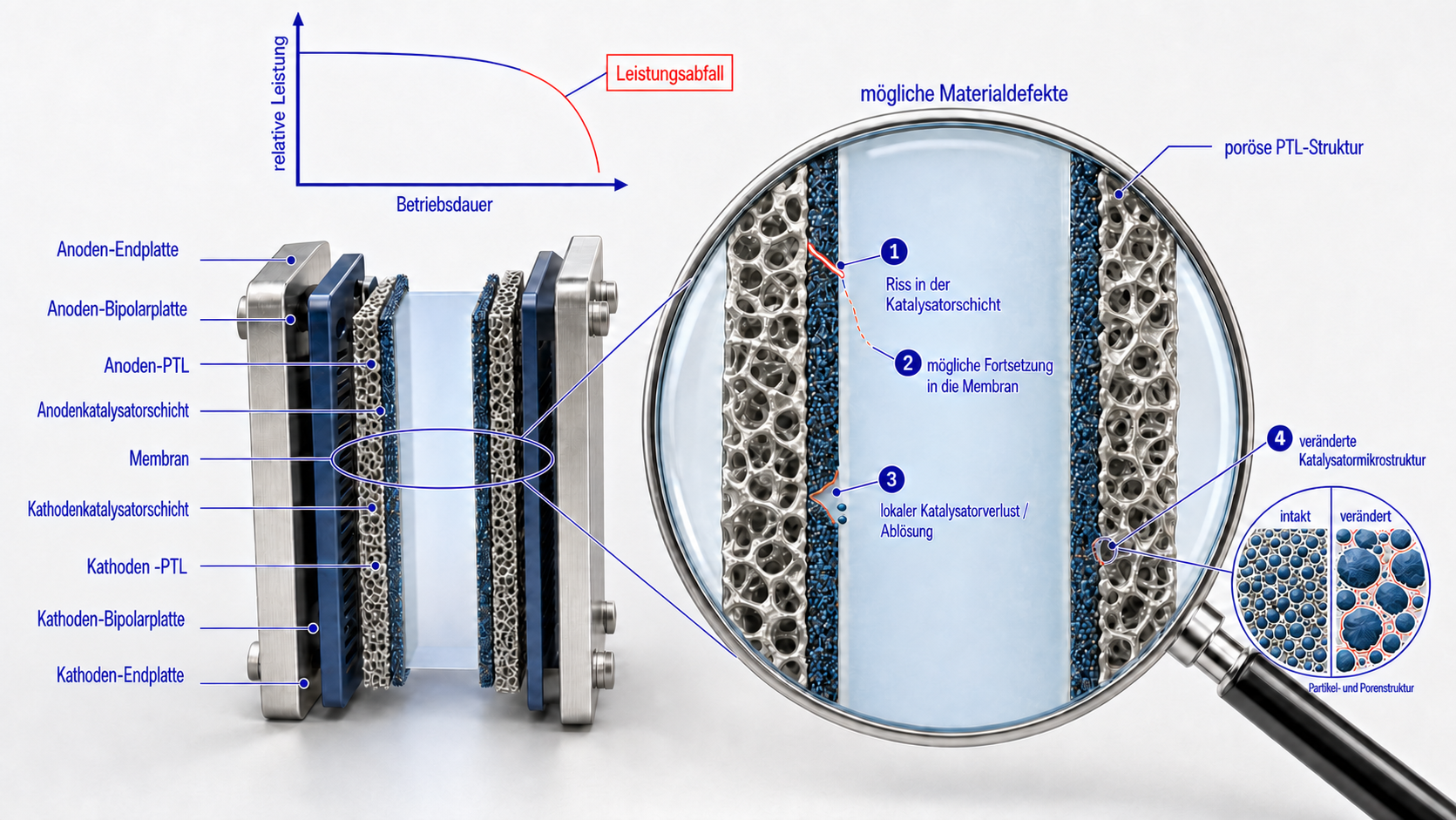
Cracks in layers, detachment or changes in material structure: this schematic illustrates examples of changes we can investigate in more detail.
AI-generated schematic illustration of possible material changes.
The example shows an electrolysis cell with a proton exchange membrane (PEM). The magnified view illustrates possible changes in the membrane and catalyst layers. Whether these changes affect performance needs to be investigated for the specific sample.
Large view and English explanation →For development teams working on electrolysis,
fuel cells and batteries.
Your development question
From the outset or during operation: which material properties or changes in layers and interfaces could explain the lower performance?
A new material formulation, a different layer structure or an altered contact design: which differences matter for your cell's function?
Our approach
Our core expertise is investigating energy materials using X-ray microscopy (XRM) and X-ray computed tomography (CT).
Our investigations focus on how material structure relates to electrochemical behaviour. We combine findings on internal material structure with electrochemical measurement data and your knowledge of manufacturing and operation.
This allows us to examine possible causes of performance deviations and assess the significance of material or design differences. We use these findings to develop potential solutions and next steps with you.
Insights from our research experience
Two examples from published studies on proton exchange membrane (PEM) electrolysis.
Why does some of the current fail to contribute to hydrogen production?
In a study, Christine Heume used X-ray microscopy (XRM) to investigate membrane electrode assemblies (MEAs) after operation in PEM electrolysers. The imaging revealed local changes in the microstructure, including thread-like structures – known as filaments – within the membrane. Complementary analyses confirmed their iridium-based composition and electrical conductivity. Modelling shows how associated parasitic current pathways can reduce local hydrogen yield.
Original study: Heume et al., Joule (2026)Does a visible change necessarily indicate a functional problem?
In a published study, we investigated how drying and rehydration affect the microstructure and function of membrane electrode assemblies (MEAs) in PEM electrolysers. Imaging revealed changes including cracks in catalyst layers. Compared with the references, however, no significant additional deterioration in electrical properties or gas-barrier function was observed over the period investigated.
Original study: Heume et al., Methods in Microscopy (2025)Are you developing other electrolysis technologies, fuel cells or batteries? Let's explore whether our approach fits your question.
Discuss your projectWorking together
Together, we clarify the development decision ahead and which investigation could support it.
We investigate and interpret material findings in the context of manufacturing, operation and function.
Together, we develop well-founded material or design options and discuss how their effects can be tested.
Our recommendations draw on investigation results and scientific experience. Their effectiveness in the specific system must be tested through further development.
About Aletheia Materials
We bring our experience with electrochemical energy materials to your development question. Together with your team, we assess findings and identify possible next steps.

Co-founder · Business development
Currently acting head of department in the field of electrolysis and fuel cells at Forschungszentrum Jülich. Co-author of scientific studies on PEM catalyst layers, material changes and parasitic loss pathways.
Talk to Eva
Co-founder · Scientific leadership
Christine has many years of experience in X-ray microscopy and the investigation of electrolysers. In parallel, she works as a Staff Scientist at IET-1, Forschungszentrum Jülich. She is the first and corresponding author of the Joule study on iridium-based filaments and efficiency losses in PEM electrolysers.
Let's take a closer look together
In our first conversation, we discuss your development question and explore how Aletheia can help. Together, we identify a suitable next step.
For your first message, a brief description of your question without confidential technical details is enough.
Email us to arrange a conversation.